Qubits, Shor, and the clock ticking on RSA: my quantum computing journey
I went down the quantum rabbit hole: Qiskit circuits, superposition, Shor's algorithm, and why the world is quietly migrating its cryptography before the hardware arrives.
Classical vs quantum
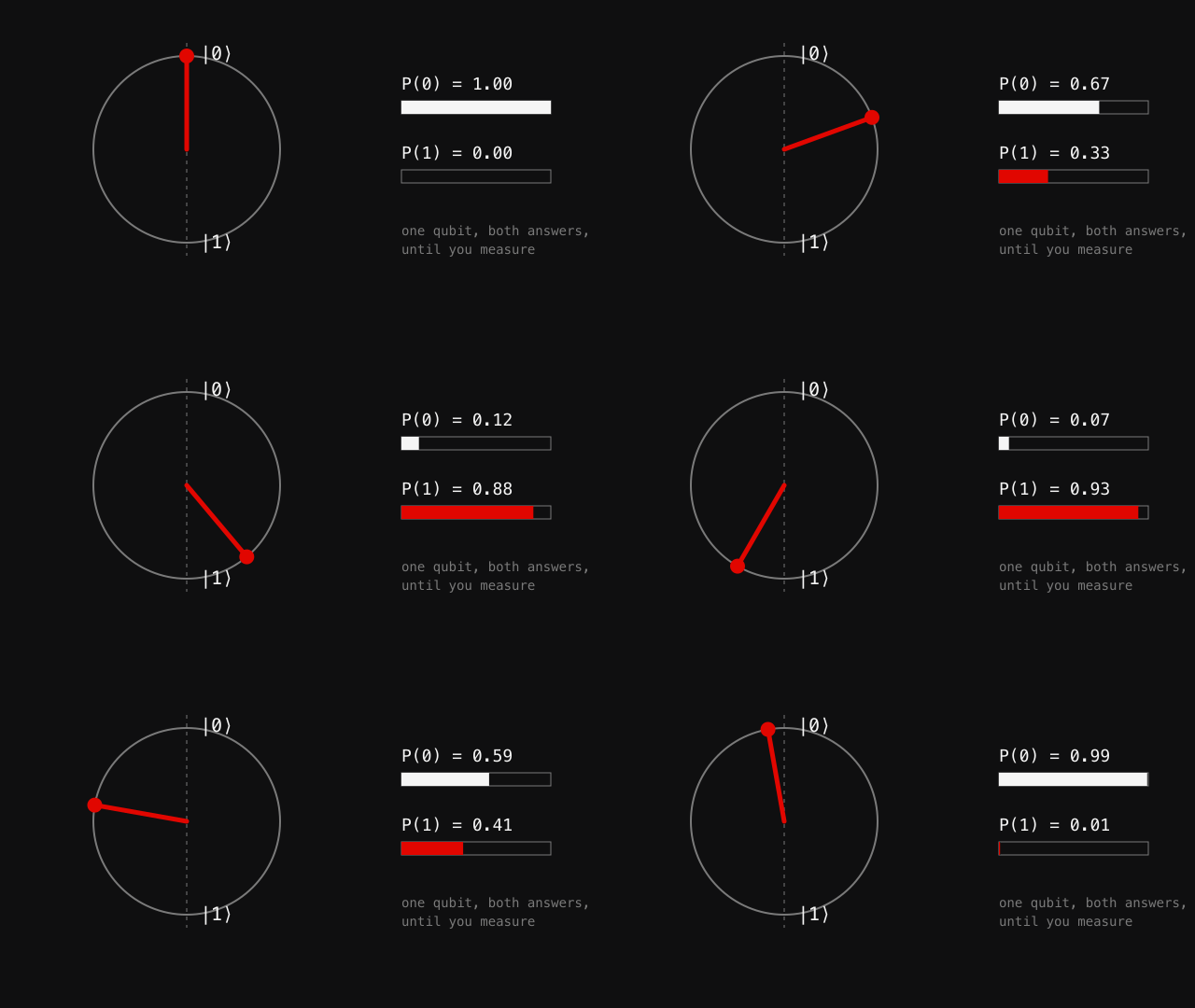
A classical computer, every computer you have ever owned, works on bits: each one is 0 or 1, full stop. A quantum computer works on qubits, and a qubit can exist in a superposition, a weighted blend of 0 and 1 at the same time. Add entanglement, where qubits become correlated so measuring one instantly constrains another, and you get a machine that explores many computational paths at once instead of one at a time.
The catch that took me longest to internalize: you never get to see the superposition. The moment you measure, the qubit collapses to a plain 0 or 1. The whole art of quantum algorithms is choreographing interference so the wrong answers cancel out and the right answer is what survives measurement.
Superposition is statistics
This is where my statistics background clicked in. A qubit's state is described by probability amplitudes, complex numbers whose squared magnitudes give the probability of measuring 0 or 1. Run the same circuit a thousand times and you get a distribution of outcomes, a histogram, exactly like sampling any random variable.
Reading quantum results is statistical inference. You are estimating the underlying distribution from finite shots, worrying about sample size, and separating signal from noise on hardware that is itself noisy. If you know expectation values and variance, half of quantum computing already speaks your language.
Getting hands-on with Qiskit
Reading about quantum got me maybe thirty percent of the way. Qiskit, IBM's Python framework, got me the rest. You build circuits gate by gate: a Hadamard gate puts a qubit into equal superposition, a CNOT entangles two of them, and suddenly you have a Bell state, the hello world of quantum computing.
Running circuits on the simulator and plotting measurement histograms made everything concrete. Two entangled qubits give you 00 or 11, almost never 01 or 10. Seeing that correlation in your own histogram beats any textbook diagram. From there I worked up through phase kickback and the building blocks that make real algorithms tick.
A Bell state histogram in your own terminal teaches more than ten explainer videos.
Shor's algorithm and RSA on notice
RSA-2048, the encryption guarding most of the internet, is safe because factoring a 2048-bit number would take a classical computer longer than the universe has existed. Shor's algorithm changes the game: on a large enough quantum computer it factors those numbers in hours by turning factoring into a period-finding problem, which the quantum Fourier transform solves exponentially faster than anything classical.
The hardware to run Shor at that scale does not exist yet. It needs millions of stable qubits and today's machines have thousands of noisy ones. But "not yet" is doing heavy lifting in that sentence, and cryptographers are not waiting.
PQC migration
This was the part of the journey with real career weight: post-quantum cryptography. NIST has already standardized quantum-resistant algorithms, ML-KEM (Kyber) for key exchange and ML-DSA (Dilithium) for signatures, built on lattice problems that even quantum computers cannot crack efficiently.
The urgency comes from harvest-now-decrypt-later: adversaries recording encrypted traffic today so they can decrypt it once the hardware exists. Anything that must stay secret for a decade needs migration now, which is why browsers, banks, and governments are quietly swapping algorithms years before a single RSA key has actually been broken.
The debrief
Takeaways from the journey so far: superposition is probability amplitudes, and statistics is the fastest on-ramp for a software engineer. Qiskit makes it tangible in an afternoon. Shor's algorithm is why PQC migration is happening this decade, not eventually. And the field moves slowly enough to learn deeply but fast enough that being early still counts.